Closures: private state, tiny surface
JavaScript closures give functions memory: private state without globals, safer APIs, and predictable behavior. See what they are, when to use them, and why.

Martin Ferret
September 8, 2025
A closure is a function that keeps access to the variables from the place it was created, even after that outer function has finished. It’s the simplest way to give code “memory” without classes or globals.
Below is a small, practical example. We’ll keep the function as-is, then walk through exactly what happens line by line and why this pattern is useful in real projects.
      function createCounter(initialCount = 0) {
  let count = initialCount;

  return function next() {
    count++;
    return count;
  };
}

const getNextCount = createCounter(10);
console.log(getNextCount()); // 11
console.log(getNextCount()); // 12
console.log(getNextCount()); // 13
How this works (step by step)
- You call
createCounter(10). Inside that call, JavaScript creates a new lexical environment wherecountis set to10. createCounterreturns the inner functionnext. Crucially,nextis closed over the environment wherecountlives. Returning the function does not discard that environment; it stays alive becausenextstill references it.- You assign the returned function to
getNextCount. Now, each call togetNextCount()runsnext(), which reads and updates the same hiddencountvariable:11,12,13, and so on. - Code outside cannot access
countdirectly (countis not a property ongetNextCount), which means the state is private by construction. When nothing referencesgetNextCountanymore, the closure (and its environment) can be garbage-collected.
That’s a closure in action: function + remembered context.
Why this pattern is valuable
- It gives you private state without globals or classes. The only way to change the state is through the function you returned, which makes behavior predictable and hard to misuse.
- It enforces a tiny API surface. Callers get
getNextCount()and nothing else; internals remain hidden. - It’s composable. You can create many independent counters (
createCounter(0),createCounter(100)) with zero risk of them interfering. - It’s testable and local. State lives right next to the logic that uses it.
When to reach for a closure
Use a closure whenever logic must remember something across calls but you don’t want to expose that state:
- Counters and toggles that persist between interactions.
- “Run once” initializers (avoid double-booting analytics, sockets, or widgets).
- Lightweight caches or debounced handlers that keep a timer or last result.
- Event handlers that need to carry an ID, token, or configuration without polluting the global scope.
A few practical notes
Closures capture references to variables, not copies. Avoid capturing large objects you don’t need, and clean up listeners or timers that close over data when you’re done.
More certificates.dev articles
Get the latest news and updates on developer certifications. Content is updated regularly, so please make sure to bookmark this page or sign up to get the latest content directly in your inbox.

Building a Vue Career in the Age of AI Coding Tools
How Junior Vue Developers Can Get Hired in 2026 and and what companies are looking for

Reza Baar
Aug 12, 2026
How YouTube Works, and Why It Plays in One Second
How does YouTube start almost any video in about a second? Here's the architectural bet behind it, and why the real call still belongs to you.

Alex Garrett-Smith
Aug 12, 2026
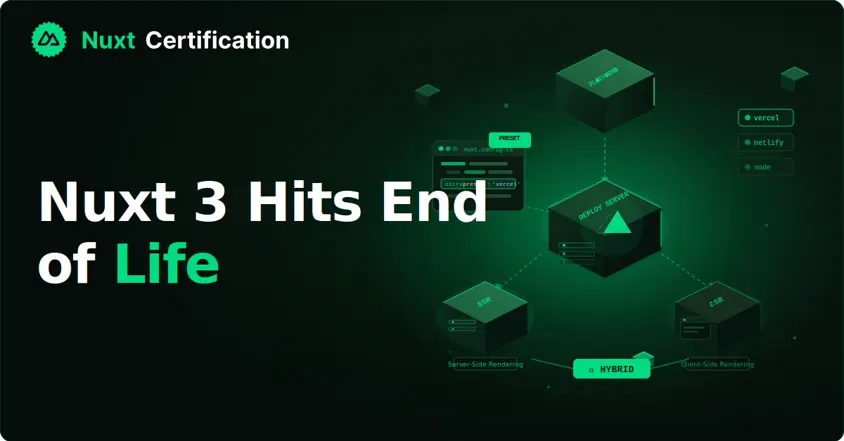
Nuxt 3 hits End Of Life
Nuxt 3 Hits EOL July 31, 2026: Your Staged Path to Nuxt 5 What the Nuxt 3 end-of-life date means, how to migrate through Nuxt 4, and when it makes sense to wait for Nuxt 5 instead.
Reza Baar
Aug 12, 2026