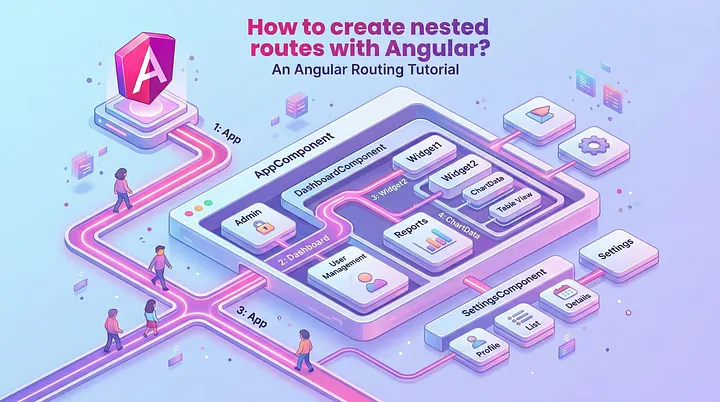
How to create nested routes with Angular?
Learn how nested (child) routes work in Angular, why multiple router outlets are useful, and how to implement tabbed navigation in complex dashboards.

Alain Chautard
April 21, 2026
Nested routes, or child routes, can be used when multiple router outlets are present in an Angular application. Why would we have multiple router outlets in the first place? Let’s take an example.
Say you have an application with multiple screens (pages) that you can navigate to. One of these screens is a complex dashboard that includes a section with tabs. You could use the router to implement navigation within those tabs, using nested routes.
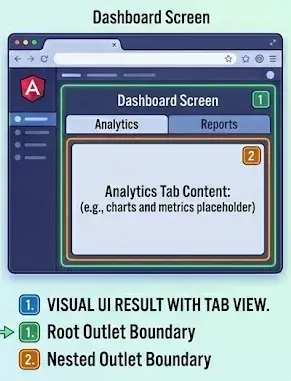
This means we have a main router outlet as follows in the App component:
      <div>
  <button type="button" routerLink=""><< Menu</button>
</div>
      <div class="tabs-container">
  <div class="tabs">
    <a routerLink="tab1" routerLinkActive="active">Tab 1</a>
    <a routerLink="tab2" routerLinkActive="active">Tab 2</a>
    <a routerLink="tab3" routerLinkActive="active">Tab 3</a>
  </div>

  <div class="tab-content">
    <router-outlet></router-outlet>
  </div>
</div>
The router config looks like this — using the children section for nested / child routing:
       {
    path: 'tabs',
    component: TabsComponent,
    children: [
      { path: '', redirectTo: 'tab1', pathMatch: 'full' },
      { path: 'tab1', component: Tab1Component },
      { path: 'tab2', component: Tab2Component },
      { path: 'tab3', component: Tab3Component }
    ]
  }
That config means that if the browser URL becomes /tabs, the TabComponent is displayed in the main router outlet, and the Tab1Component is displayed in the router outlet of TabComponent, because the empty child path redirects to /tab1, which then renders Tab1Component.
Then, if the browser URL becomes /tabs/tab3, the TabComponent is still displayed in the main router outlet, and Tab3Component is displayed in the router outlet of TabComponent.
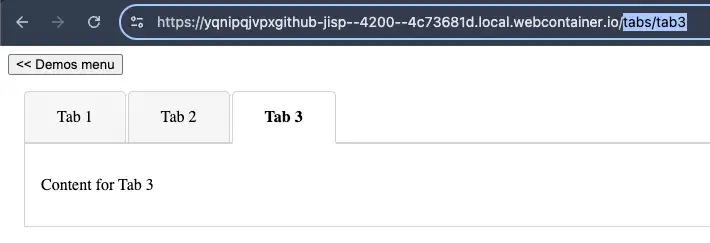
This has three important benefits:
- You can create links that navigate to a specific tab or sub-section of any given screen
- Since the current “tab” depends on the URL, switching tabs can be done using the browser’s previous/next buttons. A full page refresh would display the same tab selected.
- A URL can be bookmarked to display the application in the same state with the same tab selected.
You can see the code of my example on Stackblitz here.
More certificates.dev articles
Get the latest news and updates on developer certifications. Content is updated regularly, so please make sure to bookmark this page or sign up to get the latest content directly in your inbox.
Component Architecture for React Server Components
React Server Components let each component fetch its own data, so pages compose instead of prop-drilling. How that reshapes architecture, loading boundaries, and UX.

Aurora Scharff
Aug 20, 2026

Background Jobs with Nitro Tasks API
How to run one-off and scheduled background work in Nuxt using Nitro's Tasks API, and what to watch for per deployment platform.

Reza Baar
Aug 19, 2026
What’s new in Angular 22.1?
Angular 22.1 introduces a major change to Angular’s release cycle, moving to one major release per year. Learn what this means for Angular upgrades, versioning, and the future of the framework.
Alain Chautard
Aug 18, 2026