Subject, BehaviorSubject, and ReplaySubject
Angular’s reactive world revolves around Subjects, but the star is often the BehaviorSubject — why? Because it always starts with a value, and when you subscribe, you immediately get the latest emission (like receiving the current issue of a magazine). Meanwhile, ReplaySubject lets you go further by replaying multiple past values (no default), and a plain Subject is just “live only” — no past, no future. Let’s dig into when and why to use each.

Alain Chautard
October 8, 2025
BehaviorSubject
The most common type of Subject used with Angular is BehaviorSubject. Why is that? Because a BehaviorSubject has two exciting features that a plain Subject does not have:
- It starts with a default value, which means it is never empty.
- When we subscribe to a behavior subject, it will immediately give us the last emitted value.
Imagine subscribing to a magazine and receiving its latest published issue immediately. That’s what a BehaviorSubject does. This is helpful if you have components that need to know about the app’s current user. When the component subscribes to the “current user,” we want to get that info immediately and not wait for the next user update.
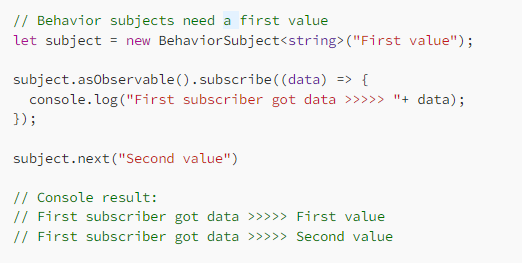
Also, since behavior subjects always have a value, they have a getValue() method that synchronously returns the current value.
ReplaySubject
A ReplaySubject is very similar to a BehaviorSubject, with two key differences:
- No default value
- Can replay more than just the last value
The constructor parameter determines how many values should be replayed to new subscribers:

Subject
A plain Subject has none of the above capabilities. When a value is emitted, current subscribers receive it, but future subscribers won’t. There is no replaying of the latest value(s), which makes plain Subjects less interesting to work with.
More certificates.dev articles
Get the latest news and updates on developer certifications. Content is updated regularly, so please make sure to bookmark this page or sign up to get the latest content directly in your inbox.
Component Architecture for React Server Components
React Server Components let each component fetch its own data, so pages compose instead of prop-drilling. How that reshapes architecture, loading boundaries, and UX.

Aurora Scharff
Aug 20, 2026
Background Jobs with Nitro Tasks API
How to run one-off and scheduled background work in Nuxt using Nitro's Tasks API, and what to watch for per deployment platform.

Reza Baar
Aug 19, 2026
What’s new in Angular 22.1?
Angular 22.1 introduces a major change to Angular’s release cycle, moving to one major release per year. Learn what this means for Angular upgrades, versioning, and the future of the framework.
Alain Chautard
Aug 18, 2026